Preschool Application Fees are a Scam

You’ve found the perfect preschool. You tour, you love the vibe, your kid loves the play kitchen—and then they hit you with a $100 application fee. Non-refundable. Just to apply.

You’re not alone. And you’re not overreacting.

This isn’t just a minor inconvenience. It’s part of a larger system that makes families pay—literally—for the chance to be considered. Let’s break down why this is happening, what’s going on behind the scenes, and what we can do about it.


What’s the Deal with These Fees?

Many childcare centers, especially private or “high-quality” ones, charge between $50 to $150 just to apply. You’re told it covers:

  • Administrative processing
  • Staff time for tours/interviews
  • Commitment filtering (to weed out “non-serious” families)

But let’s be clear—these reasons are rarely explained, never itemized, and completely unregulated.


So Where Is That Money Going?

Short answer? You don’t know.

Longer answer? It varies wildly, and that’s part of the problem.

Some for-profit centers use those fees to fund:

  • Marketing materials
  • Administrative overhead
  • Technology platforms and scheduling tools
  • Padding their operational budgets

They don’t have to tell you. And unless you’re in a state with strict disclosure laws, they legally don’t owe you transparency.


What You’re Really Paying For

Here’s the dirty truth:

You’re paying for scarcity.

You’re paying for the privilege of being one of many applicants, knowing full well that there may only be a handful of available spots.

Some elite preschools have acceptance rates lower than Harvard. Yet they collect thousands in application fees every cycle from families who will never hear back.


Who This System Favors—and Who It Leaves Behind

Families with higher incomes? They apply to 8–10 programs “just in case.”(and even then its usually more than that). But even then, they are still spending their money on application fees when it could be going to a mortgage or other needed funds.

Working-class or lower-income families? They may only be able to afford the application fee at one or two places. If they get denied or ghosted, they’re out of options—and out of cash.

The result?

  • Less access to high-quality programs
  • More stress and financial strain
  • A system where privilege buys more opportunity

Public Programs Don’t Do This—So Why Are Private Ones Allowed To?

Public programs like Head Start, state-funded pre-K, and many district-run models do not allow application fees.

They understand that access is part of the mission.

But in the private sector? It’s the Wild West. And it’s especially rampant in programs that claim high-quality accreditation.

Yes—even “gold star” programs with beautiful mission statements and shiny quality seals can charge hefty fees just to apply.


What Needs to Change

This isn’t just frustrating—it’s unethical. And it’s fixable.

Here’s what could move the needle:

  • Fee transparency laws: States like Colorado are now requiring programs to disclose what those fees cover and even offer partial refunds if no seat opens up.
  • Application fee bans for subsidized families: Vermont now prohibits charging fees to families using childcare assistance.
  • Stronger accountability in accreditation: High-quality programs should be held to high-equity standards too.
  • Public investment in child care: If programs weren’t scraping by, they wouldn’t have to nickel-and-dime parents to stay afloat.

What You Can Do as a Parent

  • Ask for a breakdown of what the application fee covers. Even if they don’t provide it, the question matters.
  • Push your local representatives to support transparency and cap fee policies.
  • Support and apply to programs that don’t charge. Let your dollars (and your voice) show what kind of system you believe in.

If you’ve ever felt like you were paying to be ignored, like your application went into a black hole, like the whole thing was rigged—you’re not imagining it. You’re in the middle of a broken system.

But calling it out is the first step in changing it.

Let’s stop normalizing this nonsense.

Let’s build a system where access to quality care isn’t something you pay to hope for—it’s something you can count on.

Please subscribe to view my next post: I’ll break down what universal childcare could look like in the U.S – affordable, accessible, and publically funded. No application fees. No gatekeeping. Just real, high-quality care and education for every child.

Disclaimer: This post is not written to criticize individual schools, directors or educators. Most programs are doing the best they can within a system that lacks funding, clear guidelines, and support.
Take Away the Walls advocates for both families, and schools-because meaningful change only happens when we support both sides of the conversation.

“Gentle Parenting is for Gentle Kids”

Gentle Parenting is for Gentle Kids… Or Is It?

Recently, a viral TikTok trend has been making the rounds, showing parents sarcastically demonstrating “gentle parenting” by passively asking their child to listen, being ignored, and then snapping—yelling or cursing to get the child’s attention. The underlying message? “Gentle parenting is for gentle kids”—and if your child isn’t naturally cooperative, it doesn’t work.

But here’s the problem: That’s not actually gentle parenting. What we’re seeing in these videos isn’t true gentle parenting—it’s passive discipline followed by frustration-fueled aggression.

• The parent starts off too passive, failing to set clear expectations in a way the child understands.

• The child, confused by the lack of structure, continues the behavior.

• The parent, feeling unheard, escalates to yelling or aggression to regain control.

This back-and-forth between too soft and too harsh creates more behavior challenges, not fewer. Kids don’t learn what to do—they learn that listening only matters when a parent is angry.

Gentle ≠ Passive (and It’s Not Just for “Easy” Kids)

Somewhere along the way, “gentle parenting” started getting mistaken for permissive parenting—where parents avoid conflict, skip consequences, and let the child dictate every interaction. That’s not what gentle (authoritative) parenting is about.

True gentle parenting is structured. It’s built on clear expectations, boundaries, and emotional coaching—not endless negotiation or ignoring behavior. And it’s not just for naturally “easy” kids—it works for every child because it’s about teaching skills, not just managing behavior in the moment.

For Educators & Parents:

This confusion between passive and gentle parenting is also happening in classrooms. Teachers are expected to redirect behaviors without clear guidance, leaving them bouncing between permissiveness and frustration—just like parents. When educators don’t have the tools to set firm boundaries while staying emotionally attuned, classrooms become overwhelming, leading to more challenging behaviors.

💡 Want to learn the step-by-step way to parent & teach with confidence and balance?

My upcoming course dives into real-world strategies for handling tough behaviors while staying firm and connected.

What the self paced course will cover: 

✅ The difference between passive, aggressive, and authoritative discipline

✅ How inconsistency confuses kids and leads to bigger power struggles

✅ Why “gentle parenting” isn’t the problem—the misunderstanding of it is

✅ How to set boundaries without yelling or being too soft—for parents & educators

📢 Until my website is up and running, I’ll be sharing updates on my Facebook & Instagram (@TakeAwayTheWalls)

✨ Follow for more updates on the launch! 🚀

Want to Join the Conversation?

If there’s enough interest, Take Away the Walls may begin hosting a monthly webinar featuring panelists, educators, and parenting experts to discuss important topics YOU have questions about! If this sounds like something you’d love to see, comment with the topics you’d like covered!

Let’s create a space where parents and educators can learn, grow, and support each other. 💙

The Quiet Collapse of Early Education: Why Staffing Shortages Matter

Preschools across the country are facing a severe staffing shortage that threatens the quality and availability of early childhood education. This problem predates the COVID-19 pandemic and has worsened in its aftermath, leaving many classrooms understaffed or even closed. The consequences extend beyond teachers – children lose critical early learning opportunities, and parents struggle to find reliable care. What was once a persistent challenge has become a full-blown crisis that affects entire communities. Below, we break down the scope of the shortage, its impact on educators, young learners, and families, and explore what can be done to address this urgent issue.

Pre-Pandemic Struggles in Early Education Staffing

Even before 2020, hiring and keeping qualified preschool teachers was an uphill battle. Low wages and high turnover plagued the early childhood field, creating a staffing crunch in many areas. In 2018, over half of Americans lived in a “child care desert” – communities lacking enough licensed child care slots . Many preschool teachers earned poverty-level wages; in one state survey, the average wage was around $10 an hour, despite more than half of workers holding at least an associate degree . It’s “not surprising that we’d have a teacher shortage” under those conditions, noted one early childhood advocate . Turnover was sky-high – about 30–40% of early educators left their jobs each year, far above average . This constant churn of staff disrupted relationships in the classroom and made it hard for programs to maintain quality. In short, the system was fragile and under-resourced well before the pandemic struck.

COVID-19’s Impact: A Worsening Shortfall

The pandemic hit the child care and preschool sector hard, intensifying the existing shortages. When COVID-19 forced center closures in early 2020, many educators were laid off or left the field. In just two months, the industry lost over one-third of its jobs – about 370,000 child care workers . Even as other industries began recovering, early education struggled to rehire staff. By late 2023, child care employment was still down by roughly 39,000 workers compared to pre-pandemic levels . One analysis warned that, at the current pace of rehiring, it could take until well into 2024 to regain the pandemic-related job losses .

Critically, many who left did not return. Early childhood teachers often found better-paying work in retail or other sectors and chose not to come back to low-paying preschool jobs . Federal relief funds (like stabilization grants) provided a temporary lifeline, helping programs stay open and even boost pay through one-time bonuses . However, those funds expired in late 2023, and the underlying issues remain . As the National Association for the Education of Young Children (NAEYC) reports, 53% of early childhood centers still don’t have enough staff to meet current enrollment needs . In many cases, classrooms sit empty despite long waitlists –  not due to lack of demand, but due to lack of teachers . In fact, 89% of child care programs cite staffing shortages as a primary reason they can’t enroll more children . The bottom line: COVID-19 turned a chronic staffing problem into an acute crisis, and recovery has been slow and uneven.

Challenges for Early Educators

For those working in preschools, the staffing shortage creates a difficult, often demoralizing environment. Educators face multiple challenges that make it hard to stay in the profession:

Low Pay and Benefits: Early childhood teachers remain one of the lowest-paid workforces in the country. The national median hourly wage for childcare workers hovers around $14 or less, often without adequate benefits. Many educators struggle to pay their own bills; some work second jobs or rely on public assistance despite working full-time in this vital field. As one Head Start professional put it, “With our current funding, we simply cannot compete with the private sector, which often pays more and involves less stress”.

High Turnover and Burnout: Understaffing means remaining teachers must do more with less. They often supervise larger groups or work longer hours to cover gaps, leading to high stress and burnout. Over half of educators surveyed in 2022 said they were considering leaving the profession earlier than planned . Research from the University of Virginia found more than one-third of early childhood teachers leave their program each year, most exiting the profession entirely . Frequent turnover not only exhausts staff but also disrupts children’s learning, as young kids constantly adjust to new caregivers.

Limited Resources and Support: Preschool teachers frequently report feeling isolated or undervalued within the education system. They often lack planning time, professional development, or even basic classroom resources. In school-based programs, preschool teachers with the same credentials as K-12 teachers may earn far less, sending a message that their work is “babysitting” rather than teaching . This lack of respect and support contributes to teachers feeling that “we are not part of the system… we’re not teachers, we’re childcare staff” as one public pre-K teacher lamented .

Competition from K-12 and Other Industries: Experienced early educators are often poached by public K-12 schools or leave for jobs in retail and hospitality that offer higher pay. A large pay gap exists even between preschool and elementary teachers; for example, the median elementary school teacher in the U.S. earns over $61,000 a year, while a Head Start teacher with a B.A. might earn around $34,000 . This wage disparity means many talented preschool teachers eventually move on to better-compensated positions, leaving vacancies that are hard to fill. “I have struggled to keep teachers… I can’t offer them more than I already do. A federal investment that would increase compensation would make such a difference,” one child care center director explained, highlighting the need to make salaries competitive to retain staff (quote from NAEYC survey) .

In short, preschool educators are expected to do critically important work for very little pay and high stress, a recipe for perpetual staffing challenges. Those who remain are often stretched thin, which impacts their well-being and the quality of care they can provide.

Impact on Children and Classrooms

Staffing shortages don’t just affect teachers – they directly impact children’s daily experiences in preschool. Young children are especially sensitive to changes in caregivers and classroom environment. When centers are understaffed, the quality of care and education can suffer in several ways:

Larger Class Sizes and Less Individual Attention: With too few teachers, centers may combine age groups or increase child-to-teacher ratios out of necessity. This means each educator has more children to watch, leaving less time for one-on-one interaction, personalized learning, or attending to each child’s needs. Overwhelmed teachers may have to focus on basic supervision instead of enriching activities. Children, especially those who need extra help or have special needs, may slip through the cracks when there aren’t enough adults in the room.

Increased Behavioral Issues: Crowded, understaffed classrooms can lead to more challenging behaviors. Young kids communicate through their behavior, and they need guidance from attentive adults to learn social-emotional skills. When teachers are stretched thin, stress levels rise for everyone. Reports from the field indicate more children are showing challenging behaviors and developmental delays post-pandemic, creating a heavier burden on educators . In some cases, centers resort to extreme measures: one preschool director admitted they expelled a child with persistent behavior issues to avoid losing overworked staff – fearing a teacher might quit if the situation continued . Such tragic choices underscore how staffing pressures can undermine the inclusive, supportive environment that young children need.

Interrupted Continuity and Learning: High turnover means children frequently face goodbyes to beloved teachers, which can be upsetting and disruptive. Consistency is key in early childhood; stable relationships with caregivers build trust and support healthy development. Each time a teacher leaves mid-year, it’s not only emotionally hard on the kids, but also resets the learning progress. New staff need time to bond with the class. Unfortunately, many centers report that vacancies and revolving substitute teachers have become the norm. As one Head Start program leader observed, having fewer classrooms open concentrates the highest-need children together, resulting in “extraordinary levels of child and educator stress.” Children in these rooms may miss out on the calm, nurturing atmosphere that helps them thrive.

Fewer Enrichment Opportunities: When a preschool is barely able to meet minimum staffing for safety, anything beyond the basics falls by the wayside. Field trips, special art or music activities, and even regular outdoor play can be curtailed if there aren’t enough adults to supervise. Teachers handling double duty have little bandwidth to plan creative curriculum or tailor activities to each child’s interests. The classroom experience may become more custodial than educational, which is a lost opportunity during the critical early learning years.

Impact on Families and Communities

When preschools and child care centers can’t hire enough staff, families inevitably bear the burden as well. Parents rely on early childhood programs so they can work or attend school, and for children to learn and socialize. The staffing crisis has radiating effects on family life and the broader community:

Long Waitlists and Scarce Child Care Slots: Across the country, parents are encountering unusually long waitlists for infant, toddler, and preschool programs. In a national survey, 38% of providers said their waiting lists have grown longer due to staffing shortages . Centers that don’t have enough teachers simply cannot enroll as many children. One survey found nearly one in five childcare staff positions is currently vacant, translating to thousands of unfilled child seats. As a result, it’s not uncommon for parents to put their name on multiple lists (including an application fee) before a baby is even born, yet still not secure a spot by the time parental leave ends. In Pennsylvania, for example, over 38,000 children were on waitlists in early 2023, an 18% increase from the prior year. This shortage of childcare slots forces families into tough choices.

Parents Forced to Quit Jobs or Cut Work Hours: If you can’t find daycare and you’ve got kids, you can’t go to work, as one business expert plainly noted. The childcare shortage is directly linked to workforce issues in other sectors, because parents (especially mothers) often reduce hours or leave jobs when reliable care isn’t available. Some families patch together interim solutions—relying on relatives, or one parent staggering work hours to cover child care—but these are not long-term fixes. In an alarming trend, parents are making major life decisions because of childcare insecurity. “We’ve never seen parents more desperate and more frustrated,” said one resource and referral agency leader, noting calls from parents who are quitting their jobs or even deciding not to have another child due to the lack of childcare options. When skilled workers drop out of the labor force to fill in as full-time caregivers, local businesses lose employees and productivity suffers. Thus, preschool staffing shortages act as a drag on the economy as well as a strain on families.

Higher Costs and Financial Strain: The laws of supply and demand are hitting child care. With too few staff to meet demand, many programs have had to raise tuition rates for the slots they do offer, in order to pay higher wages to attract teachers or simply to stay afloat. Childcare costs were already a huge expense for families; now some are seeing price hikes that put quality care even further out of reach. Childcare typically costs more per month than a mortgage on a standard American home. One national report found the cost of child care and preschool has risen at almost twice the rate of inflation over the past 30 years. Parents who are already stretched thin must weigh paying more for care (if they can find it) against other household needs. On the flip side, programs that don’t raise fees struggle to hire anyone, perpetuating the cycle of low pay and shortages. It’s a no-win situation: either parents pay more than they can afford, or educators earn less than a living wage – and often, both are happening at once. This financial squeeze is pushing childcare providers out of business and pushing families to the brink. In one survey, over half of childcare centers knew of multiple programs in their community that had closed in the last 6 months due to these economic pressures.

Ultimately, when childcare is unavailable or unaffordable, the whole community feels the effects. Employers lose reliable workers, children lose early learning opportunities, and economic growth is stifled. A childcare center owner in Idaho summed it up: “It’s hard to make ends meet… I don’t want to raise tuition too high for parents, but [I feel] it may end up happening” . The ripple effects of the preschool staffing crisis extend far beyond the classroom walls, which is why many now call it a community crisis, not just an education issue.

Toward Solutions: Investing in the Early Education Workforce

Addressing preschool staffing shortages will require concerted effort and policy solutions that match the scale of the problem. Experts agree that simply expecting parents to pay more or teachers to endure low pay is not sustainable – systemic investment and innovation are needed. Here are several recommendations and ideas gaining traction to help fix the pipeline and support the educators our youngest children depend on:

Increase Compensation and Benefits: Nearly every analysis points to low pay as the root cause of the staffing shortage. To attract and retain qualified teachers, early childhood jobs must become financially viable careers. This means significant public investment to raise salaries closer to parity with K-12 teachers, and to provide benefits like health insurance and paid leave. As one national report bluntly stated, “Childcare is a market failure that will require sustainable public investment.” Many advocates are calling for federal and state governments to subsidize caregiver wages, rather than shifting all the cost to parents. For example, Former President Biden’s 2024 budget proposal included $600 billion over 10 years to expand childcare access and boost worker pay. While that level of funding is ambitious, it illustrates the understanding that only broad investment will solve this crisis. Competitive compensation would help stabilize the workforce, reduce turnover, and draw new talent to the profession.

Grow the Pipeline of Early Educators: In addition to keeping current teachers from leaving, we need to bring more educators into early childhood careers. This can be done by lowering financial and educational barriers for new teachers without sacrificing quality. Scholarships, loan forgiveness, or tuition-free training programs (like the T.E.A.C.H. Early Childhood scholarships in many states) encourage people to pursue early childhood education credentials. Apprenticeship models and paid on-the-job training can also help entrants gain skills while earning an income. Some policymakers have considered adjusting hiring requirements to expand the pool of eligible teachers. For instance, Colorado temporarily eased certain preschool teacher qualification rules to fill positions amid its rollout of universal Pre-K . However, any such moves must balance the need for more staff with maintaining program quality. The ideal approach is to recruit and prepare more educators by making training accessible and appealing, not simply lowering standards. Mentorship programs, career ladders, and partnerships with high schools and colleges can all encourage the next generation of early educators to enter – and stay in – the field.

• Improve Working Conditions: Another key to retention is improving the daily working environment for preschool staff. This includes maintaining reasonable teacher-to-child ratios so that educators aren’t overwhelmed. It also means providing adequate planning time, professional development opportunities, and support for teachers in the classroom. Investing in substitutes or float staff can ensure that when someone is sick or at training, the classroom isn’t left shorthanded. Policymakers and center directors should also look at creative ways to reduce burnout, such as offering mental health support, coaching, or mentorship for teachers. Recognizing early educators as professionals – through fair pay, but also through respect and inclusion in decision-making – goes a long way toward making them feel valued. When preschool teachers feel supported, they are more likely to stay, and the quality of care improves.

• Leverage Public Schools and Community Partnerships: Some communities are addressing shortages by integrating preschool programs into public school systems or other community institutions. Public schools that operate pre-K classes can often offer better salaries (on par with K-12 teachers) and benefits, which attracts teachers. Partnerships between childcare centers and businesses or universities can provide additional funding or resources. For example, an employer might sponsor a child care center for its employees, funding teacher salaries above the market rate because it benefits the company’s workforce stability. States and cities are also experimenting with incentives for educators, such as tax credits for early childhood teachers or stipends for those with certain credentials. These approaches treat early education as essential infrastructure – much like elementary schools – that requires public and private support.

Sustained Funding and Policy Attention: The consensus in the early childhood field is that there’s no quick fix; a long-term commitment is needed. Temporary grants helped during the pandemic, but programs now need reliable funding streams to plan for the future. This could mean increased state subsidies for each child, expanding government programs like Head Start, or even moving toward universal preschool in the long run. Policymakers are urged to view child care not as a private luxury but as a public good that underpins the economy. The payoff for society is significant: every dollar invested in high-quality early childhood education yields benefits in better educational outcomes, higher lifelong earnings, and reduced social costs down the road. In the near term, stopping the hemorrhaging of talent from the sector will require emergency measures (to boost pay immediately) coupled with structural reforms. By tackling the compensation crisis and supporting those who educate our youngest children, communities can begin to rebuild a stable early education system post-pandemic.

A Collective Priority

The current preschool staffing shortage is not just an “educator problem” – it is a challenge that impacts children, parents, employers, and the economy at large. When classrooms lack teachers, children miss out on critical early learning, parents are left scrambling for care, and businesses lose employees. Conversely, investing in solutions yields broad rewards: teachers can build fulfilling, long-term careers; young learners get the consistent, quality education they deserve; and families and employers gain stability. In short, quality early childhood education is a foundation for thriving communities. Solving the staffing crisis will require all stakeholders – government, businesses, and the public – to recognize early education as a priority and back that recognition with resources. The issue may be complex, but the imperative is simple: support those who support our children. By ensuring preschools are well-staffed with dedicated and qualified educators, we all invest in a brighter future for the next generation and for our society as a whole.

Sources:

  • 1. Center for American Progress – The child care sector has not made sufficient progress
  • 2. Foundations for Families – Child Care Staffing Challenges Remain (NAEYC January 2024 survey data)
  • 3. PBS Wisconsin – Numerous Factors Causing Wisconsin Preschool Teacher Shortage
  • 4. University of Denver Butler Institute – Podcast on early childhood workforce (transcript)
  • 5. NAEYC – Early Childhood Educators and Families Face Rising Challenges as Relief Funds Expire (Feb 2024 brief)
  • 6. National Head Start Association – Head Start Workforce Crisis Brief (Feb 2023)
  • 7. CEHD, Univ. of Minnesota – A vicious circle: child care staffing crisis leads to real consequences for children
  • 8. The 19th News – Day care waitlists are so long, moms are quitting their jobs…
  • 9. KPMG Report – Crisis in childcare and the state of work in America (via Foundations for Families)
  • 10. Michigan Public Radio – Why 60% of Michigan’s public preschool teachers consider leaving

An Educator’s View on Deconstructing the Early Childhood Education System

We teach Apple* Curriculum here, you can be as creative you want and we encourage all styles of teaching. That was the elevator speech I received during my interview when I asked the administrator about their Curriculum. I thought, Wow! This is the real deal, I never thought I would find a school that teaches Apple* Curriculum. You see, I had taught for 7 years prior at a small lab school with 50 students that teaches and trained teachers using Apple Curriculum. With this in mind, the school I was interviewing at was a unicorn school. At least, that’s what I thought. I began using the Apple* Curriculum in my 3- & 4-year-old room the way I was taught by an Apple* Curriculum Specialist.

About 6 months pass by, and I am called into my administrator’s office. They told me, “A parent has a concern because their child seems to be regressing in your classroom.” I was shocked. I have never had a child regress in my 9 years of teaching. I asked in what manner was the parent concerned and how I can help. The administrator of the school said, “All I know is the parent wants their child removed from your room and placed in another teacher’s room. I also think its important for you to know that we have to pull you from being a teacher and make you a substitute instead. That’s what the owner of the school is demanding since you aren’t a traditional educator”. I emptied out my personal items from the classroom that day, I took down my family portrait on our School Family Tree. I said “Goodbye” to my room. A couple of days later I noticed that my Self-Regulation Center was removed, as well as the “We Wish You Well” Board. Then worksheets, sight words and word walls entered my old room. The problem? They wanted me to teach sight words to 3- and 4-year-olds to get them ready for kindergarten, they asked why I wasn’t erasing and redoing the students classwork.

This way of educating children is a serious problem. However, it is more common than people think.

Some educators would say that I am a nonconformist and say that the way the school was wanting me to teach was traditional. I would disagree. I believe that yes, I am a nonconformist, but I am also a traditionalist.

 Take a moment and think about the ways that children learned before schools became buildings. The children would learn mathematics, science and reading by helping a parent in the kitchen, they learned social emotional skills by playing with peers and family members for hours on end. They learned hands on practical, real-life skills.  They did not have someone telling them to hurry up and do their best so they can succeed in kindergarten.

I’ve never really understood why we need to prepare children for the future. Sydney Guerwitz Clemons said it best when she wrote, “We don’t starve to prepare for a famine. We fatten them up to the best of our ability and hope they survive.”

The Need for Occupational Therapy

Take Away The Walls would like to celebrate OT month by introducing Megan Lambert OTR to the educational forum. I interview Megan where we discuss why children struggle sitting still, the change in outdoor playground equipment and how its changing child development, and things to look for if a child needs OT support.

Melanie Ingram: Hey Megan! Thank you so much for being here and sharing your Occupational Therapy experience with Take Away the Walls.

Megan Lambert: Hi! You are welcome, I am so glad to be here and talk about this with you.

Melanie Ingram: Usually when I have interviews, I start with having our guest share a little bit about their career and experiences to where they are now. When I first heard about Occupational Therapy (OT) was about 6-7 years ago I had a mentor mention a particular grasp that a student was doing, and she mentioned, “I’ll bring this up to their parent since the parent is an Occupational Therapist.” When I heard this I was really really confused because I thought, “What does being a therapist for peoples careers, and jobs have anything to do with a writing grasp?” but since then, I took time to learn what OT is all about and obviously you are not a therapist that talks to people about their jobs. SO would you mind elaborating a bit more on what OT actually is?

Megan Lambert: Of course, Occupational Therapy helps support people with their tasks, any task that they perform throughout the day. OT is very broad and there’s alot that goes into it but that’s what I love about it the endless possibilities.

Melanie Ingram: So you do lots of focusing on the whole body verses a particular section or one area?

Megan Lambert: OT has the mindset of , “What the goal is for that particular person?” but with children it is a little different. We get to work on the sensory processing and we get to touch on the mental, physical, spiritual, emotional regulation and focus on the whole body.

Melanie Ingram: I love that you are able to work with people on their whole self. Not very many industries really focus in on that. Can you tell me a bit more about your favorite part of OT?

Megan Lambert: I think my favorite part it is getting to form a relationship with the person and what they goals are for themselves. There was a little boy I worked with who was about 7 years old and he was getting made fun of because he couldn’t ride a scooter. After working with him he was able to successfully ride a scooter with his friends. Kids don’t understand why they can’t do something, all they know is they are struggling with this. That’s when OT comes in and we help with that skill they are wanting to work on and make it fun.

Melanie Ingram: Can you tell me a little bit about your current role as an OT?

Megan Lambert: Yes, so I collaborate with the families and the client and we focus on their goals. Either they have delays in development and we come up with strategies to either adapt or utilize rehab when considering their needs and goals.

Melanie Ingram: For our readers, can you elaborate more on ADAPT vs REHAB?

Megan Lambert: Adapt is when we use a method to adapt the activity or environment to enhance the client’s performance to complete the specific task. So for an example when using scissors we would use loop scissors. This supports clients that have weak grip or need to focus on hand control to be able to cut a piece of paper. Rehab is basically strengthening exercises that help support the child to help promote function. But we make it fun, so we do wheel barrel races and bear crawls. I had one child who couldn’t flatten their hand. Every day they came in we worked on flattening their hand to encourage flattening their hand, and the strengthening exercises such as wheel barrel races and bear crawls help support that. We start the day by gross motor movements and obstacle courses and then are able to go into the classroom and then we will sit down in a classroom. That’s one thing that I don’t really understand about education and having children sit in chairs. I couldn’t even do that! Are you familiar with heavy work?

Melanie Ingram: a little but please mention a little more for our readers

Megan Lambert: Heavy work is anything that has a push or a pull movement so picking up a heavy ball and moving it, pushing a wheel barrel. it helps with their sensory system and helps them focus. This helps them focus on fine motor.

Melanie Ingram: To add on that, I’m a huge advocate for allowing children to move to be successful but I have worked and observed in various classrooms. A couple years ago I worked at a program and an educator mentioned to me that they can’t have their students move around prior to sitting down for a lesson because they can’t calm down. So if the children can’t “calm down” what exactly is missing? It makes me wonder if the movement wasn’t long enough or the children required different movements to help them be successful.

Megan Lambert: That sounds more like a transitioning goal and that is something we work with everybody on.

Melanie Ingram: Is that like a goal that you see from parents, educators, administrators? Where do you typically see that goal being requested?

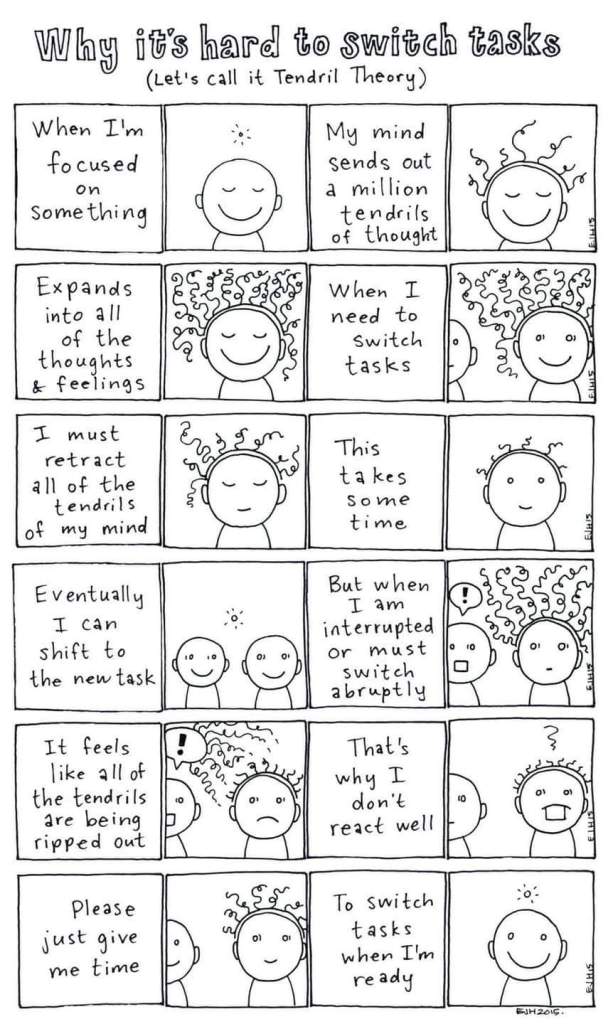
Megan Lambert: Actually everywhere, it is a common one. Most of the ones I was writing were for the children that had sensory processing goals. They would struggle transitioning from the gym to the therapy room and we would write specific goals for that transition. Many times we would use visual timers, sometimes provide a transitioning toy. It is a hard one for children to work through. It is even a hard one for adults. Imagine if we were running or moving and then being told to stop. How would that effect us as adults? We would kind of be scrambling around trying to focus on the next thing.

Melanie Ingram: There is this comic that I saw posted the other day and it’s called the Tendril Theory- it has a person working on a task and when being told to end something abruptly it essentially cuts off the “tendrils” and the person has a hard time reacting well.

Melanie Ingram: Over the past few years I’ve seen more children that require a need for OT.  Especially in Kindergarten “The New First Grade”, children are sitting in desks more- but this is also due to Covid19 with social distancing and being 6 feet apart. 

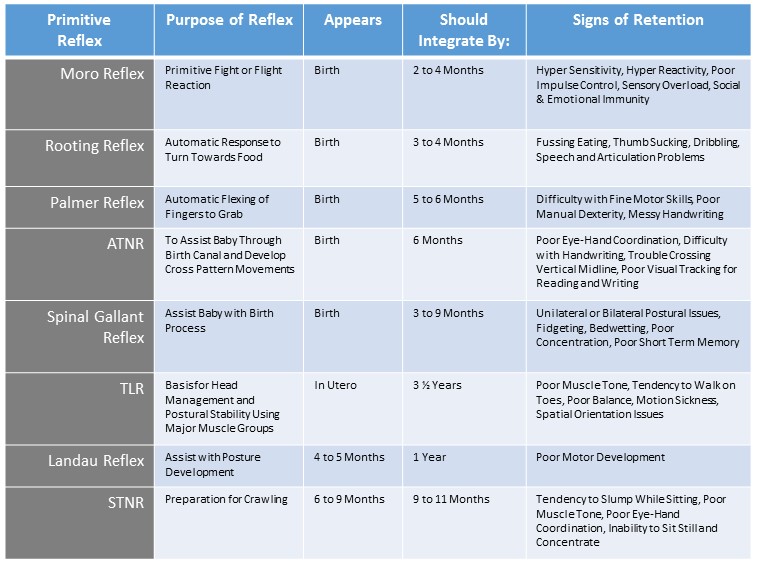
Megan Lambert: When you sent over the questions earlier I actually got really excited about this because I immediately thought of primitive reflexes.

Megan Lambert: We all have these reflexes ingrained in us since we were babies. There’s one called the Gallant Reflex. If you were to take your finger down a babies spine their pelvis will shift. This reflex helps them balance. After a few months the reflex slowly disappears as the baby grows and the movements are more controlled and voluntary. However, there are children who still have the primitive reflexes and their development is delayed. Another one is STNR that is another precursor to crawling; so anytime you flex your neck and your arms when getting up from the ground to crawl. If a person still has the STNR reflex after its supposed to already be integrated that child will struggle with concentrating, eye coordination, which also effects the handwriting.

Melanie Ingram: Basically the entire body is connected and if one part of the body isn’t integrated, delays will show up in various ways.

Megan Lambert: The good thing is, there are Occupational Therapy exercises that can be used to help develop the motor skill. Knowing the developmental milestones is very important for early intervention.

Melanie Ingram: From what we’ve discussed about OT there are lots of opportunities for gross motor play and movement. In the OT building there are things to hang on, swings, rock climbing etc.  As we discussed there has been a shift in classrooms, where children don’t have the opportunity to move as much as they need to. I see materials being taken out of the classroom, out of the playground because its “dangerous”. This makes me concerned as an advocate for education because we are taking so many sensorimotor things out of the classroom because its considered dangerous and then asking ourselves, “Why is my child struggling with handwriting, and has poor coordination?” . Then we send them to OT to do the very things that were deemed dangerous in the classroom.

Megan Lambert: At the end of the day, children are going to do the movements that they need to receive the sensory input their bodies need, either at home or at school. That is really interesting though to hear the education side of things. Everything ties together, for the whole body development.

Melanie Ingram: That’s actually a topic I’d love to come back to in further detail with another article because there’s alot to unpack, but I’d love to hear a bit more about the senses.

Megan Lambert: There is a program called Astronaut Training Program, this was a sensory program I was trained on during a field experience. This helps with the vestibular system, and we would spin the children on these boards. There is this term called nystagmus, where your eyes move back and forth at a rapid pace and blurry vision, this happens especially after being spun around multiple times. Adults have a more developed nystagmus function and we get dizzy just looking at someone spin. Some children didn’t have that, others fell down and I had one that even threw up after being spun. We work through this vestibular exercise and it helps the child function better.  Children spinning around on their own also helps support the vestibular system. I guess in a sense this circles back to our conversation earlier about taking away sensory materials- it would certainly be a disservice to the children.

Melanie Ingram: I honestly believe that every school and program needs to have an onsite OT, Applied Behavior Analyst, and a Speech Language Pathologist. I think it would be a huge help to programs and provide specific insight to human development that would help and benefit everyone. I had a child that needed heavy work, and after a little bit kinda gave up and then went back to their version of grounding seeking input.

Megan Lambert: It actually sounds like they needed a different form of heavy work and maybe if they did that activity a little longer they won’t *need* to be seeking that input anymore. If a child doesn’t want to do the activity, you have to come up with a way to work towards their goal in a different way. So for an example I had a child who loved anything batman and we ended up doing “batman races” to help them reach toward their goal. Usually if you find something that interests the child, they will be more excited to try the activity even if its hard. Also doing lots of encouragement and encouraging that hard work is okay too. Sometimes children don’t necessarily understand that hard work has to happen and everything doesn’t always come easy.

Melanie Ingram: If you could describe a typical day in OT in a *perfect* world

Megan Lambert: In a typical day in OT I look at the schedule of who my clients and I come up with a plan/goal for that particular child. Usually the goals are for a 6th month period. I use a software program called Clinic Source, it has a checkpoint and percentage of where and when the goal is being completed. I also input information such as progress notes, treatment and evaluation plan and plan of care. So if I had 8 kids to work with in the day I would be writing up 8 different plans. Usually goals aren’t completed immediately and they aren’t instant because children are still developing and this takes time.

Melanie Ingram: So you can’t just go into a room and say, “Child A has to work on developing their vestibular sense”. There is actually a whole process and plan.

Megan Lambert: Oh yes,  when you show parents the scores it provides the evidence “this is why they need OT”. The results provide where they are developmentally based off of the average development.

Melanie Ingram: Are you allowed to give the evaluations or does a pediatrician provide them?

Megan Lambert: I do give the evaluations but the pediatrician does have to refer. There is certainly a profess to be referred to OT. They come in and I talk with the parents and I get information on the child, their needs and their interests. but also what the parents want as well.

Melanie Ingram: What would you say to look for if a parent or teacher thinks a child needs to be referred for OT?

Megan Lambert: I would start by encouraging them to familiarize themselves with the developmental milestones. You can find these on the CDC page. If a child is, lets say 6 years old and is performing gross motor skills as a 2 year old, I would recommend seeing the pediatrician to get referred to see an OT.

Melanie Ingram: Megan, I want to thank you for taking the time to speak on the forum. As you know, I truly believe that to help the whole child all professions that help a child should come together to support the child and their development. I know that I certainly learned alot through this time talking with you and I am sure others will learn as well.

Megan Lambert: You are welcome, thank you for having me!


Thank you so much for reading along, as and always, please be sure to rate, review and subscribe to help other educators and advocates alike to find support in this community.

Occupational Therapy Resource provided:

https://www.toolstogrowot.com/blog/2016/01/11/primitive-motor-reflexes-their-impact-on-a-childs-function

Behavior Intervention in Educational Environments

In this article I am showcasing Courtney Anderson, a Board Certified Behavior Analyst (BCBA), where we discuss a bit about her career path, increase of maladaptive behavior since the start of the pandemic, and behavior intervention in the classroom.

Melanie Ingram: Hi Courtney, I just wanted to start by saying thank you and for joining us on the forum at Take Away the Walls. I am really looking forward to hearing your views on behavior intervention in educational environments. I wanted to start by asking you to share a little bit about your journey in this field and how you got to where you are now.

Courtney Anderson: Of course! I am glad to be here! So like many Behavior Analysts do, I started off with going to school for forensic psychology to become a member of the FBI Behavior Analysts Unit but then quickly realized that TV is nothing like real life. In college I had an opportunity to do an internship as a classroom aide for early learners in a classroom that was tied to an autism clinic. That’s when it really started to kick off and I found my niche; I enjoyed working with the ones [children] that no one really knows what to do with. The ones where teachers tend to sigh or just roll their eyes; such as aggression, nonverbal, or needs one on one support. I’ve had opportunities to work with early childhood education, up to adults.

Melanie Ingram: So one of the things that I have noticed, in the past few years, but especially past year with the start of the pandemic is that there has been a rise in need of behavioral and social emotional support in (and out) of the classroom. Is this something that you have seen first hand as well?

Courtney Anderson: I think Covid has certainly had a part in behavior.. Brene Brown said it best when she said, ” Genetics load the gun, and environment pulls the trigger.” I think there’s many behavioral and emotional underlying stuff for alot of children. Covid is the trigger for alot of kids. It could be one of those situations where they don’t have the best support system and with parents it is hard to manage school, kids, jobs etc. I’ve been doing this for 10 years now and I have seen a general increase across the board since starting in this field. It is part awareness, more people are aware of needing support. Whether they are neurotypical or neurodivergent. When I started doing this cases were 1 in 100, and now children are being diagnosed 1 in 48. As a Behavior Analyst I don’t see a problem with an increase in those needs. I always say everyone has something they need help with.

Melanie Ingram: I may get a little flak when mentioning this, because I did in my college classes… But I don’t agree with using “clip down” behavior charts in a classroom. Personally, I think it is a lazy form of classroom management. As a Behavior Analyst what are your recommendations or suggestions for educators that want to do something else aside from using behavior charts?

Courtney Anderson: So I don’t mind reinforcement systems, those are fine but I don’t like the clip up, clip down behavior charts. This system reinforces calling out kids who are struggling, while also having the other children on a pedestal. But its also calling out boys vs girls. In most cases, girls are able to sit still longer and listen, whereas boys are more physical and move around more because of their different rates of maturity and development. One system that I saw was a “button system”, there were 3 buttons for each child, posted in front of the room. If a child makes a “red”[bad] choice they lose the button, if they make a “green” [good] choice they can earn back their button. This system is set up to be a “loss system”. The first contact that the child has with this button is ” you did something bad so you lose a button”. They were working for a sticker or a skittle for the entire day… a child can’t be expected to work for a single item given at the end of the day.

Melanie Ingram: I can definitely see some children, (myself included in this), asking themselves, “what is the worst or best thing that could happen if….?”

Courtney Anderson: Exactly! At this point teachers are not even looking for the good behavior, just looking for behavior to punish. Ultimately it sets the child up to fail. There is a principle in Behavioral Analysis called Negative Reinforcement where getting rid of something that is non-preferred, you’ll keep doing it. Ex: Your child is crying in the store for candy, and you know you don’t want to give the candy but you do because it stops the screaming. That is Negative Reinforcement for the parent/adult. Also, in the future the child has learned that if they scream they will get candy. That is why many teacher use reprimands, or punishment systems because it stops the behavior quickly. It doesn’t build repour, it doesn’t build skills that replace the negative behavior. A method that has better turnout are Group Contingencies; this encourages the children to work together towards a goal vs. “everyone in it for themselves”. Prosocial behaviors, encourages cooperative behavior.

Melanie Ingram: What would you suggest for any teacher that is struggling with distractions in the classroom, transitions in a neurotypical and neurodivergent classroom?

Courtney Anderson: My go- to is to suggest choices and warnings. Such as, “We have 5 minutes until it is time to clean up.” Choices give children a sense of control. Stating what you want to not what you don’t.

Melanie Ingram: YES! I completely agree with stating what you want to see vs what you don’t. I remember my first year teaching I had told a child, “Stop running [on the sidewalk]!” My mentor mentioned, “Say walk on the sidewalk.” So I did. I mentioned to her, “Wow! It’s like magic!” Which obviously we know its not magic, its just the way their brains work.

Courtney Anderson: haha! yeah their brains just catch on to that last word! Another point that is beneficial is let children have an opportunity to refuse. I was taught early on in my career [we call it escape] when they don’t want to do something, “escape trumps all”. No matter what they have to follow through and meet your demands. Such as “Go write your name” and we would be there to physically guide them until they will do it independently. So some schools do reprimand for non-compliance. I do think its really important for children to self-advocate, even for things such as needing a 5 minute break. On the other side of things, if you are forcing a kid to learn or forcing a kid to sit through a learning opportunity what are you actually teaching them? Are you teaching them the actual lesson that you want them to learn, or are you teaching them how to be compliant and get things over with? If your goal is to get a kid to be compliant and to just sit and be quiet then you’ve succeeded. If your goal is to have the child actually learn the material and be able to apply it later, you have failed. The child won’t absorb the information when forced to sit through it, whether they do it calmly or or emotionally. It sets up a bad relationship with the learning environment and creates a circle of fight and force. Letting kids step away gives them a chance to be open to learning. Instead of making them, look at what’s keeping them from wanting to: tired, confused, distracted, hungry, bored, etc and address their needs before adding to their expectation.

Melanie Ingram: One of the things I was taught early on in education is that behind every behavior there is a reason. An analogy that I saw [and shared] the other day is behavior is like a dandelion where we only see the top part of the flower and cut it down, instead of taking care of the root. Ex: We see punching and hitting at the petal, but the root shows “this child is having a hard time entering group play”.

Courtney Anderson: Exactly! One of the basic things we teach to educators, parents, and paraprofessionals is the Basic Functions of Behavior: “Why people do what they do?”

  1. Access- To get something
  2. Escape- To escape or avoid something
  3. Attention- Positive or negative attention, because any attention is “good” attention.
  4. Sensory- Because it feels good.

Knowing why a child does something makes a difference on how a situation is handled.

Melanie Ingram: What kinds of tools, or resources would you suggest to educators in neurotypical and neurodivergent classrooms?

Courtney Anderson: I love math manipulatives because they can be used in any type of way. Some of my favorites are Wikki Stix and Play Doh. Especially for boys because these materials are very tactile and boys are more likely to be physical driven, vs girls are more language driven. If you want them [boys] to be focused or listen it helps them be physical, like having a conversation while walking or playing with Play Doh.

Melanie Ingram: Interestingly enough, I am a more tactile learner; so whenever I talk to a boy in my class typically I will be walking around with them while talking and problem solving because it not only helps me, but it also helps the little one move around as well.

The last question is about resources for assessments or screenings that you recommend? A screening I’ve used in the past is Ages and Stages (ASQ).

Courtney Anderson: The MCHAT is a great screening tool for ASD{Autism Spectrum Disorder]. I actually use the ASQ-3 for bumping up developmental skills across different learners because it’s what docs use at annual check ups! Other assessment tools are the VBMAPP is which age-referenced through 48 months and has a guide book that gives examples of how to write IEP goals based off of it. The AFLS is functional living skills assessment and the ABLLS is a basic living skills assessment that includes areas of math, reading, and writing along with developmental skills. Both are available on Amazon for around $40-$60 dollars and I photo copy out pages (or use digital materials online) so I don’t have to keep buying new ones.

Melanie Ingram: Courtney, I wanted to thank you so much for taking the time to speak on the forum. It was great that you shared your input and experiences of behavioral intervention in classrooms, and I know that teachers across the board will really benefit from these resources and tips you have provided. The goals I have for the Take Away the Walls Forum is to do a few series, and there a few points we discussed today that had me thinking about adding to the series rotation!

Courtney Anderson: Of course, thank you so much for having me. I would love to continue to be apart of this, help support you and doing future interviews with you!

This article was especially important to me, because I believe that early intervention is important for every child, and every educator. I know that we will be hearing from Courtney in the future for more information concerning her expertise.

Thank you so much for reading along, and as always, please make sure to rate, read and subscribe and review to help other educators in our community to find support in this community.

My Favorite Podcasts and other news too…

This week I’ve had an opportunity to be actively involved with the NAEYC Public Policy Forum this week advocating for early childcare and educators. If you want to know more about the NAEYC Public Policy Forum, please refer to the NAEYC website: https://www.naeyc.org/events/policy-forum

Here are some of my favorite podcasts that keep me uplifted, inspired, and productive.

Child Care Bar and Grill

Child Care Bar and Grill, Jeff Johnson and Lisa Murphy

Jeff Johnson and Lisa Murphy, Early Childhood Advocates and Play Based Learning Advocates take on various educational topics and discuss these topics using their background in education and research. They ask thought provoking questions and are not afraid to say, “Why?” when it comes to specific practices in the classroom. A couple of my favorite episodes include: 04/01/2019- Balanced and Barefoot with Angela Hanscom, and 06/15/2018- The Power of the Pause.

Headspace, Andy Puddicombe

Radio Headspace, Andy Puddicombe

This is a podcast I listen to every morning on the way driving to school, or on the way back to my home. This podcast encourages meditation, practicing mindfulness and taking away the stress and anxiety. Who doesn’t need this in 2020/2021?! The podcasts are anywhere between 5-15 minutes, which provides small bite sized mindfulness training that you can take with you throughout your day. I had an opportunity to practice this mindfulness in the classroom the other day and some children even joined in. A few of my favorite episodes are 10/7/2020- Fight Club Rules Apply, and 06/04/2020- Being vs. Becoming.

The Teacher Career Coach podcast

The Teacher Career Coach Podcast, Daphne Williams

Daphne Williams is a former educator, turned education consultant, to instructional designer, to a business helping teachers transition out of the classroom or encouraging a teachers side business. Taken from Daphne’s website, “MY MISSION IS TO CREATE THE COMMUNITY FOR OTHER TEACHERS I WISH EXISTED WHEN I WAS FIRST GETTING STARTED WITH MY ADVENTURE OUTSIDE OF THE CLASSROOM.” One of the things that I really enjoy when listening to this podcast is it seems as though Daphne is literally sitting across from my table drinking a green tea or a coffee along side me while talking about life. Some of my favorite episodes: 02/25/2020- The Pros and Cons of Leaving Teaching During the Pandemic, and 12/17/20202- Five Reasons You Should Start Your Side Hustle.

The Living Easy Podcast

The Living Easy Podcast, Lindsey Maestas

Lindsey Maestas starts off every podcast by saying, “We were never promised that life would be easy, but when you do life together it becomes easier and much more fun”. Lindsey enjoys sharing her experiences of life concerning motherhood, being a spouse, traveling, starting and building a business, and living life with joy. She also isn’t afraid of discussing the “deeper” aspects of life and topics that most people would sweep under the rug. The podcasts help me feel more positive throughout the day and have helped me see a different perspective of being human. A couple of my favorite podcasts include, 11/04/2019- 6 Ways Your Phone is Changing You, and 12/28/2020- 11 Lessons I Learned in my 20’s That Changed My Life.

Share some of your favorite podcasts below! Did you like what you read? Please *like*, subscribe, and share Take Away the Walls page.

Big Emotions in a Micromanaged World

The Decline of Social Emotional Skills, Part One

Fred Rogers with Francios Clemmons, “Officer Clemmons”

Anything that’s human is mentionable, and anything that is mentionable can be more manageable. When we can talk about our feelings, they become less overwhelming, less upsetting, and less scary.” – Fred Rogers

Mr. Fred Rogers has been on the rise in Hollywood the past few years. Rogers spread positive learning experiences and talked about hard topics such as divorce, death, fears, all while keeping the child’s emotions and whole self in mind. After seeing mindless tv shows aimed for children, Rogers decided to use television as a positive tool to reach children and families to discuss social and emotional concepts.  I often see on the news students’ in older grades struggle with mental health issues. At the time seeing the news, I thought *ignorantly* how grateful I am that I don’t have to handle those types of emotional responses in a primary classroom. But then a voice popped in my head and said, “Just because there is not these kinds of trauma in the classroom on any given basis does not mean that primary children are not dealing with big emotions too”. A child screams, throws blocks, chairs, maybe runs around punching the other children, maybe the child tried or did bite you. Or maybe, this child has a hard time maintaining friendships, perhaps whines or tattles often. I’m sure at this point a student or child may have popped in your head! Or maybe not and that’s ok! These responses are showing us that this child that lacks the skills needed in social emotional development and they need our support.

“There’s no ‘should’ or ‘should not’ when it comes to having feelings. They’re part of who we are and their origins are beyond our control.” Social emotional skills come from a specific area of child development; these social emotional skills envelop “The core features of emotional development include the ability to identify and understand one’s own feelings, to accurately read and comprehend emotional states in others, to manage strong emotions and their expression in a constructive manner, to regulate one’s own behavior, to develop empathy for others, and to establish and maintain relationships. (National Scientific Council on the Developing Child 2004, 2). An adult that does not have social emotional skills CANNOT model or teach a child those skills. Many times, as adults we find ourselves repeating the exact same behaviors, discipline, and punishments we experienced as children, whether positive or negative. I can’t tell you how many times I’ve said, “haha! my mother’s voice just came out!” When children develop their emotions in a positive way, research shows that these children constructively develop their emotions have a higher success in academia, AND develop healthier and stronger relationships in and out of the classroom. I had an opportunity to interview the owner and program coordinator at a local HighScope program. It is her belief that “when discussing ‘social emotional skills’ we should actually say “emotional-social”; because first you have to teach the emotions before you can help them [the children] navigate through the social side of things”. Are children able to do academics without social emotional skills? Yes, however, it will be more challenging long term.  

I hope you enjoyed part one of The Decline of Social Emotional Skills, and look for part two coming soon…

On my coffee table

I will be the first to admit that I don’t usually sit down to read leisurely books. As of late, I have been more into podcasts (I’ll do another post all about that too). I have a tendency to read books about education and varied practices in the classroom. Over the years, I have collected quite a few books and I would love to share them with you! Most can be found on amazon* (and my coffee table) at a reasonable price.

1.The Playful Classroom by Jed Dearybury and Julie Jones, PhD.

The book starts off with the first chapter titled, “The Case for Play” and boy does it deliver. One of the things I love about the authors is they aren’t afraid to get into the research and details about play and why less play in the classroom is failing our children and education. Jed and Julie walk the readers through their life experiences, researched based activities and how to implement this in your classroom the next day. This book is an easy read, because the authors write as though you are having a cup of coffee with a good friend.

2. Balanced and Barefoot by Angela Hanscom

This book is a phenomenal approach written by a pediatric occupational therapist. Angela noticed that children started falling out of their chairs more often, lacking basic sensory skills. More children were becoming enrolled in occupational therapy-which was actually pretty rare. Using her skills as an occupational therapist, Angela created a program called Timbernook that encourages free play in an outdoor environment that fosters physical movement and whole child development. I had an opportunity to talk with Angela and visit a local Timbernook program, and it completely opened my eyes to a new way of education and learning. Children were rough playing, getting dirty and climbing trees- all three of these things are not typical at a traditional school. All of the children were eager to learn, took risks and gained confidence in their abilities. Angela spoke at a TEDTalk which I will link here: https://www.youtube.com/watch?v=PXLaoDucF0k

3. The 7 Habits of Highly Effective People by Stephen R. Covey

I received this book from a teacher of mine the night I graduated high school. In the book, my teacher wrote an inspiring letter that expressed they read this book every summer prior to the new school year- and passed the book along to me as an encouragement to continue being a leader and mentor to others. Since receiving 7 Habits, I have read it every summer before the new school year, as a way to show respect to my former teacher. Ironically, this book was also a required reading in my professionalism class in college so it was a win-win for me! The main message of this book is to create change and be effective in your personal or professional life, you yourself need to take a step back and reflect on your own self. Each chapter includes practical steps and implementations that you can use in your life. I would highly encourage any educator and professional to take a look at this book. If you don’t like reading- there is an audio version through audible*!

What books have you been reading lately or left an impression on you? I’d love to hear your thoughts!

*DISCLAIMER: These companies do not sponsor this post, I added these companies since these are the places where I received these books.